On "Rainy Day": Lucia Berlin's Fragment as Intervention
I bought A Manual for Cleaning Women because I loved the title, and because Lydia Davis—a writer I greatly admire—wrote the foreword. [Correction: now that I’m looking through it, I see my partner purchased it for me, possibly for the same reasons I mentioned, and inscribed it in a meandering Berlinean fashion—moving easily from heartfelt support of my writing to playful innuendo to an oblique reference to something serious (I forget exactly what) going on between us in October of 2015…I don’t ever want to come home to a home where you don’t live with me.]
In the foreword, Davis spends significant space on Berlin’s stories’ “balanced, solid structure[s]” and the “illusion of naturalness” with which they transition from subject to subject. She quotes a critic who suggests that this illusion results in stories whose climaxes are written around (rather than toward); they pop, in other words, like space in a drawing whose lines don’t combine to represent so much as they prompt you to see what’s on either side of them (I’m taking this idea from a Diebenkorn quote I’m too lazy to look up…something about learning to see the line as divisive of space, but the important point is it goes beyond basic gestalt continuity and closure concepts—though these certainly likely apply to most readers’ conceptions of the “whole” in Berlin’s work). [Correction: I’m not too lazy to look it up: “In the late forties I worked to make a line with a strong form (or space) on either side of it. It seemed I could see only one side of a line until one day I knew I could see both sides at once.”]
In 2015, I was struggling creatively, and I wasn’t in the right space to read Manual. I didn’t like to be reminded of all the short stories I could have written while I was writing the novel I lost track of, though I remember enjoying moments within the stories—e.g. the old miner who pastes leaves of the Saturday Evening Post on his cabin walls and reads his walls all winter, snowed-in. But even that moment suggested the feeling of being inside your own head when you read, the connections between home/shelter and the written word, and those connections, for me, were broken at the time.
But now, energized, in part, by Lydia Davis’ book of essays (in which the foreword to Berlin’s Manual is collected), I have returned to Berlin in a better space. I picked up Evening in Paradise, and was struck by “Rainy Day,” which I think exemplifies some of the unique ways a fragment—or non-“traditional” flash piece—can succeed (where “traditional” stories can’t or don’t).
The story is told/spoken from within a detox facility to an implied second character (the narrator’s habits of speech—“man…you know”—suggest a listener). The beginning of the narrator’s story (the story within Berlin’s story) is a sentence whose punctuation functions as a Diebenkorn line—it invites us to see both sides at once (additionally, we are made aware that we are double listeners): “My old lady and me went over to the bleachers…it’s nice—real quiet and lots of room.” Berlin’s ellipsis is natural to the voice and suggestive of off-the-page dialogue that results from the declarative sentence about going to the bleachers (What’s it like there? / Why’d you go to the bleachers?). The ellipsis is both a moment of non-speech (for the narrator) and speech (for the audience). The answer to the implied, or actual, question brings us, equally, into two spaces at once: the bleachers, defined by their ample space and relative quiet, and the detox, which we know is crowded, and, likely, not very quiet. I think we can reasonably read the em dash as a gestural precursor—a quick glance around the room—to the ironic statement. (And it’s this gesture that sets up the offbeat, enigmatic line that struck me as Berlin’s invitation to participate in the story’s physical “reality”).
“Then it started to rain and she started to cry.” commences seven straight sentences in which the action of the story within the story rises (“I kept on asking….What’s the matter?....‘All the cigarette butts are getting wet.’”), climaxes (“Shit, so I hit her.”) and falls (“She went nuts, cops took her to jail and brought me here.”). Within this story within, Berlin examines the disparity between correlation and causation (as a fictive element and as a problem of perception/ perspective in life). This disparity gets recast in the fragment’s structure; the climax of the story within is not the climax of “Rainy Day.” The main story’s action continues to rise as the narrator attempts to resolve the “trouble” he’s in: “…when I sober up I start to think. Alcoholics think more than most people….I drink just to shut off the words.” Thinking, here, is defined as a flow of words, so to think “more than most people” is to be unable to shut off the flow, or to have a higher-than-usual flow (whether that flow is directable is another topic).
“Shit, what if I was a drummer?” is the story’s climax.
The drummer line sounds random (an effect of being an alcoholic—i.e. immediate evidence to support his claim that alcoholics can’t shut off the words), but I think it’s rooted in the physical—a shaking hand or nervous knee-bounce, the effects of withdrawal—bodily spasms that remind our narrator (and/or those around him) of the actions of a drummer. Again, Berlin invites us into the scene, asks us to observe/experience something she has not described (Davis touts Berlin’s “concrete physical imagery,” but here Berlin has gone beyond the physical, off the page). To decline this invitation is to miss the climax (she makes it easy to accept; it’s fairly parallel to the climax of the story within). To miss the climax of “Rainy Day” is to miss an opportunity to feel compassion for the narrator (or, since that’s difficult, given his nonchalant abuse of his “old lady,” to miss what Berlin seems to feel for her character—compassion might be going too far, but call it an extra-writerly, human interest in the kind of person whose story mostly goes untold). It’s also possible that she used this narrator to explore form, and she cared nothing for his type. Berlin, who struggled with alcoholism, is said to have produced much of her best work after getting sober, so for her (and for anyone else) it might be a metaphor for compartmentalization of addiction and its effects on creative generation.
“Rainy Day” teaches us what the best fragments can teach us: we’re addicted to stories with “written-toward” climaxes (i.e. we’re wired to want what we’re used to). This is why I read the gotcha moment at the end as a trap. The narrator says he read an article in Psychology Today, the last time he was in detox, that “proved alkies thought more.” Alcoholics, according to the article, “scored higher on tests than normal people.” There was “just one thing [alcoholics] scored bad on…but I can’t remember what it was.”
“Rainy Day” is an intervention. Berlin challenges her audience to consciously, rather than subconsciously, appreciate story structure, and to go beyond appreciation, to participate, to enter the framework. Once we’re inside the story (because of the fact of POV) we’re inside the narrator’s mind, so it’s impossible to judge the narrator for not remembering because we can’t remember either. If we find ourselves enjoying our superiority, we’ve missed the effect. For to enjoy superiority, in this case, is to stop thinking, to shut off the flow of words, to step out of the frame and see only one side of the line.

How We Name Our Mountains (Reading Response)
How We Choose Our Fathers: Snyder in the Teeth
Well, since you wondered how things turned out between me and my dad—
No. This first: my friend Dave’s dad lives up on San Juan Ridge, off Lazy Dog Road, outside of Nevada City. Cedar groves and mine tailings. Deer in your garden. The Yuba River. In college I helped them clear brush before fire season. Dave’s dad, Scott, edited one of Snyder’s non-fiction books (I forget which one—something from the old days of Earth House Hold). Anyway, there was a picture, a snapshot gone slightly sepia, of a toddler Dave in a diaper on neighbor Gary’s knee. Snyder, looking relaxed and happy on a hot night, wears only white briefs. I remember being jealous of the boy in that picture. Who did my dad know? Gary the part-time pastor at Rohnert Park Bible Church. Our neighbor worked for the water district.
“Late October Camping in the Sawtooths” is a poem about me and my dad. We never camped in the Sawtooths, but we backpacked all over the Trinity Alps, Marble Mountains, and northern Sierras when I was growing up. And, before my junior year at Davis, we took a trip into the Trinities and camped under Sawtooth Ridge (I imagine much naming in the west was done by whatever white man was manifesting his destiny; saws, apparently, were often on hand). My dad had been cancer-free for a few months. He was still weak, but, in another sense, he’d never been stronger. I don’t remember everything we talked about. God, probably, at some point. But the trip was not about the words we didn’t know how to utter. It was about doing the small things around the fire, washing dishes in the stream, pulling on sweaters after sundown. I remember we made freeze-dried scrambled eggs one morning and threw the package in the fire before we read the directions, added too much water and had to cook them for twenty minutes. And while we took turns stirring, a doe and fawn came down into the skunk-weed meadow and we watched her teach the fawn about evasion, charging at it until it bolted away, and then circling it to charge again. She was playing bear. I wonder if he thought about my four younger siblings then, about mom raising them alone. He cried a couple times. Once at the story of standing, sick, in his bathrobe, urine bag filling up on his thigh, watching his neighbor mow his lawn. This neighbor had grown up in the backwoods of Minnesota, and had been stricken with polio as a boy. He had a prosthetic leg, and it took him a very long time to mow even the standard postage stamp—so long, in fact, that my dad, in health, had started just mowing his lawn when he did ours, a don’t-mention-it between reticent men. And then, sick, he watched Mike finish his own lawn and keep going, pushing the mower around our twisted Gravenstein in painstaking quarter turns, leaning on the handle and taking a step with his good leg and swinging his prosthetic forward in kind of waggly dance. My father said he wept at this, and he wept while he said he wept.
There was levity, too. We fished and read and talked about the family. And every evening we lived a version of Snyder’s poem, a poem, in its essence and rhythm (and meter and lineation), about the methodical, contemplative moments that every high country backpacker has known a hundred times. The activeness of light and shadow—night falls faster in fall in the mountains: “Sunlight climbs” and “shadows merge.” The trochaic meter (at the beginning) and the grammar (it’s a run-on) of the first sentence reinforce the imagery and the feeling it produces of dark and cold cinching into the gorge. Then when the person enters the poem it is also active: “Building” and “Drinking.” And there’s a simple causal relationship between the actions: stoke a fire for hot water for tea. This sentence feels like it will be a fragment—until, after the dash, we get the imperative “Pull…and roll….” It’s worth noting that the lines before the dash contain a recurring short “i” sound, and there is no long “I” personal pronoun in this poem that might only seem personal to those who don’t recognize its general applicability to the common experience of backcountry campers.
The other thing about that trip was we watched the sunset twice on the hike out. The last half mile before the trailhead was ascending switchbacks. We stopped to watch the sun go down red, and then we hauled ass up the trail fast enough to bring the sun back up again. I was in the best shape of my life, and my legs were burning. I don’t know how he did it. Like I said, he’d never been stronger.
I Have Decided
Mad River, 1988
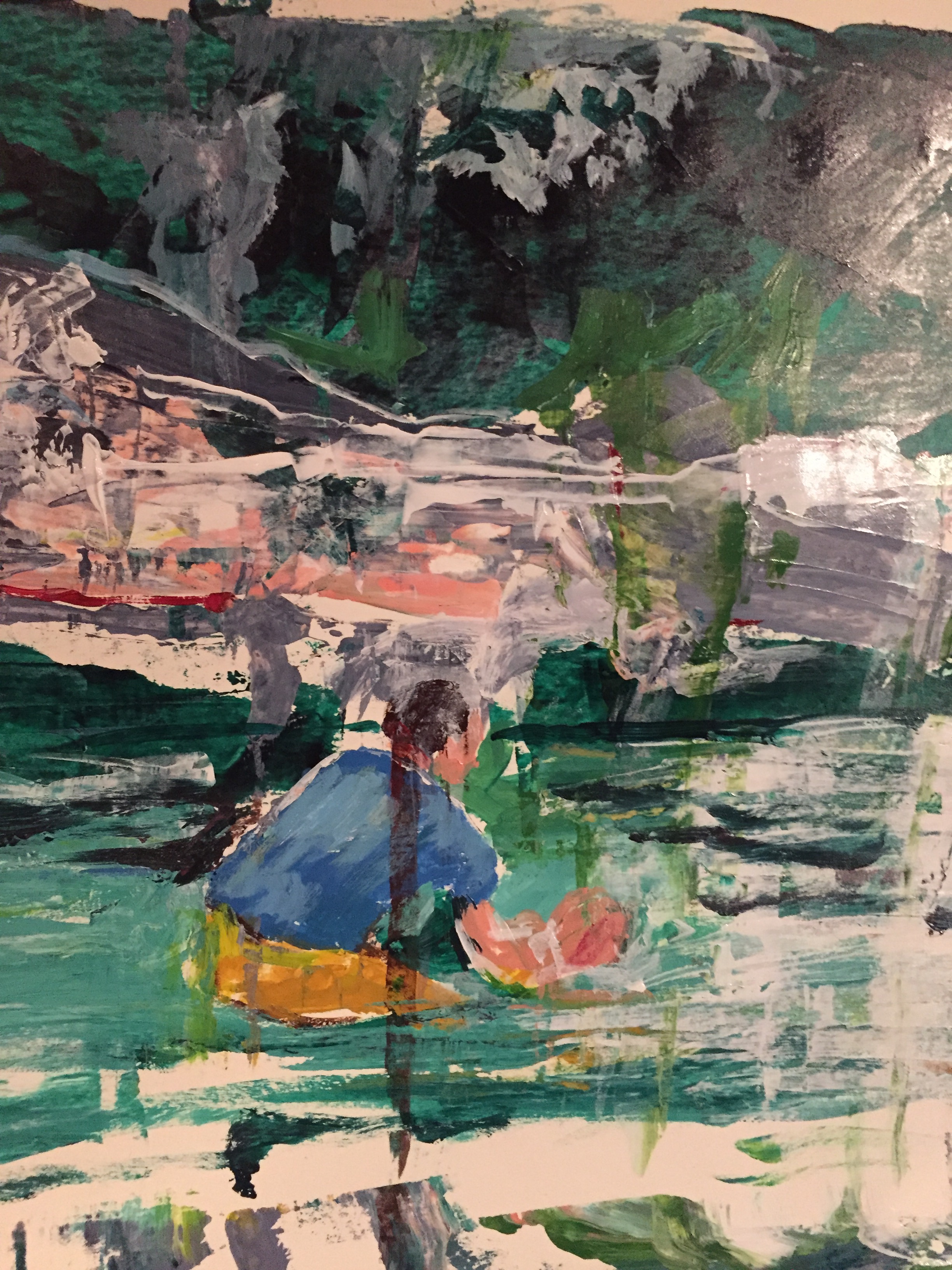
There were maybe a dozen witnesses, a couple of carloads, with kids ranging in age. It was August and overcast, close to the coast. It must have been a Sunday, after church. The meeting, we called it.
They stood on the banks of the Mad, somewhere between Kneeland and Arcata. The Mad runs north from the Trinity Alps through timberland, heavy with sediment load sloughed off logging roads and carried down creeks through clear-cut swaths. Milky turquoise water, dirty-blond rock, green riparian fringe.
The women wore dresses, covered their heads, stood proudly demure. Singing belief in the Anabaptist habit. They looked like pioneers, a patchwork quilt hung in the wind. They eyed the river as if seeking a shoal to cross.
The kids you could’ve mistaken for the residue of the Humboldt hippy ethos (our group was communal—potlucks, tool-sharing, work parties, a general predilection for home-birthed, home-grown, and home-sewn), home-schooled with mail-order Christian curriculum. They looked innocent, dorky, cultish, singing along with their parents.
The men burned with evangelical energy. They had changed into river clothes, shorts and t-shirts and sneakers, but were somehow more solemn for the casual contrast. They led us in prayer. They uttered the names of those who would walk into the river. Everyone nodded and said amen.
I wondered then what they, the believers, saw in my face. I could not talk to god, and I felt perpetually embarrassed around people who (said they) could. And I was scared of the water, scared that the moment I was saved would be the moment the current caught me. I would see the bank of faces receding. I would panic and flail, sink, swallow water and go quickly cold. But I couldn’t imagine an end of consciousness. I thought I would slide with the silt to the breakers and be found on a pyre of driftwood. They would light it on fire, still singing, and I would burn, but my mind would remain among the living, and I would finally be able to go wherever I wanted, to bear witness to another reality, to normalcy. This may have been a result of all the talk of eternal life. Nobody bothered to explain why we wanted to live forever. And at no point was baptism described as symbolic.
It has always seemed certain that the search for religion selects for, and reinforces, what’s found. I think I felt this long before I could articulate it. Though I don’t know. The search for the words might be what produced the effect of my “knowing.” I know enough about how language occurs to me to allow for that. And a feature of this knowing is that I think I felt it before. But by the time I was born, for sure by the time I was baptized, born again, my father’s search was long over. He knew all he needed to know about his god’s saving grace. So when he pulled me aside in the serious tone he reserved for matters of the soul and asked the question—are you ready to be baptized?—he might have believed he was giving me a choice.
I pretended to consider the question. This was the beginning of feigning seriousness to protect my father’s feelings. His anticipation of the outcome led to the outcome.
These were my first fictions, the faces I made to betray his faith. To this day I wish he had called me on it. Or I wish I’d said, “No. I can’t. I don’t know what it means. I’m sorry. It’s too much to believe.” And I would have said it if I thought he’d agree that faith should not be thrust upon the young.